24H NEWS

LIKE Us On Facebook

Please Wait 20 Seconds...!!!or like our page
Showing posts with label VISA_IMMIGRATION. Show all posts

Sunday, August 21, 2016

VIDEO-Filipina going abroad as wife of a Greek, required to attend the CFO Guidance and Counseling Seminar


Many of our community members asked us what is the  CFO Guidance and Counseling Seminar, so for Filipinos/a  leaving the Philippines as a Fiance, Spouse or Partner of a Foreign National need to attend the CFO Guidance and Counseling Seminar

Or lets say it better Filipinos going abroad as fiance(e)/ spouses / partners of foreign nationals or former Filipinos are required to attend the CFO Guidance and Counseling Seminar in order to secure the Guidance and Counseling Certificate (GCC) and the CFO registration sticker.
You need this certificate to renew or apply for a new passport at the Department of Foreign Affairs (per Department of Foreign Affairs Order Nos. 11-97 Implementing Rules and Regulations for Republic Act 8239, “Philippine Passport Act” and 28-94 ). You will also need to present this certificate together with your spouse/partner visa, at the Immigration office at the international airport on your day of departure.
Watch the video 

Requirements (with or without visa)
1. Original and photocopy of two (2) valid identification cards with photograph;
2. Duly completed guidance and counseling form;
3. If married, original and photocopy of marriage contract on security paper from the National Statistics Office (NSO) or from the Local Civil Registry Offices (LCRO); or original and photocopy of Report of Marriage duly registered by the Philippine Embassy/Consulate or the Department of Foreign Affairs (if married abroad);
4. Other documents as may be required by the counselors; and
5. Payment of PhP400.00 counseling and registration fee.
Additional Registration Requirements for those with visa:
1. Original and photocopy of passport;
2. Original and photocopy of visa (if available/applicable);
3. Original and photocopy of Immigrant Data Summary for US-bound emigrants (except for K visa holders);
4. Original and photocopy of Confirmation of Permanent Residence for Canada-bound emigrants;
5. Original and photocopy of Certificate of Eligibility for Japan-bound emigrants;
6. Original CFO Guidance and Counseling Certificate (after satisfactory completion of the GCP); and
7. Duly completed emigrant registration form.
Procedures:
1. Go to www.gcp-appointment.cfo.gov.ph
2. Answer preliminary questions to verify if you need to attend the Guidance and Counseling Program
3. If eligible for the GCP
• Indicate your e-mail address
• Click on the link sent to your e-mail
• Choose your preferred date of appointment
• Provide personal information of yourself and of your fiancé(e)/spouse/partner
4. Print barcoded confirmation form or save a digital copy (PDF format) in your mobile phone or tablet
5. Take note of date of appointment. Go to CFO-Manila on confirmed date (at least an hour and a half before appointment) and bring the complete set of required documents.

Note: If  you have any problem come to our page on facebook and reported it
https://www.facebook.com/GreekFilipinoCommunity/

post signature

Tuesday, July 5, 2016

Illegal foreigners Who Cannot Pay are being Sold for Organs, smuggler tells Greek authorities


Illegal immigrants unable to pay for their journeys across Greece borders are being sold to organ traffickers, an smuggler has told to tsismosaonline.com news reporter.
Nuredin Wehabrebi Atta, who was arrested by police in 2014, is the first foreigner given witness protection by Greek authorities, after revealing details that have led to arrests of dozens of alleged members of an elaborate criminal network trafficking drugs, arms and migrants from Africa to Europe.
Those who were unable to pay for their voyages “were sold for €15,000 to groups, particularly Egyptians, who were involved in removing and selling organs,” Atta claimed.
His testimony led police to an alleged trafficking network which they broke up on Monday, arresting 23 and issuing arrest warrants for another 15 people in raids across Greek Borders.
The group included 25 Eritreans, 12 Ethiopians and an Greek who police said belonged to an organisation that had smuggled thousands of migrants into Europe from Africa.
The arrests were part of a lengthy investigation conducted by  police connected to Atta's testimony that revealed cells in Europe.
More than €526,000 and $25,000 in cash was recovered in June from the  headquartered in a perfume shop near the city’s central station.
The former people smuggler was sentenced to five years in prison in February for his role in the operation.
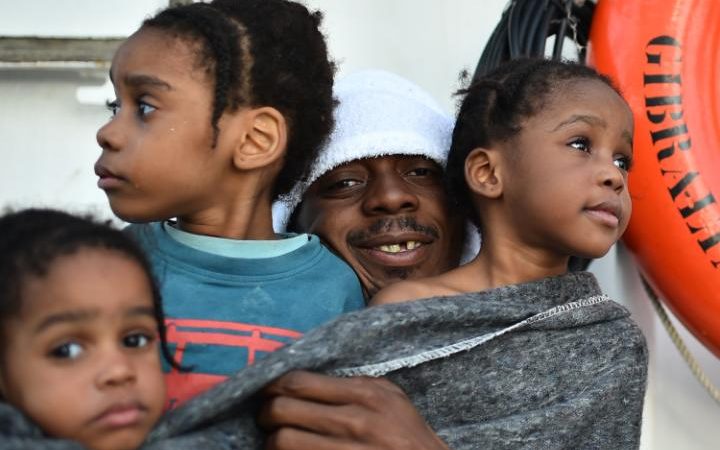
A father holds his three daughters after a rescue operation of migrants off the Libyan coast
A father holds his three daughters after a rescue operation of migrants off the Libyan coast, Source: APP
He said he decided to collaborate “because there have been too many deaths in the sea” and referred in particular to the 2013 tragedy in which 360 people were killed at Lampedusa, although he said he was not involved in it.
“The deaths that we are aware of are a small part of it,” Atta told police. “ In Eritrea alone there have been victims in 8 out of 10 families.”
A report released by Amnesty International on Friday revealed horrifying accounts of sexual violence, torture and religious persecution on the people smuggling routes from other Countries to Greece.

post signature

Thursday, March 24, 2016

More than 5,000 migrants and refugees in the port of Piraeus


At the port of Piraeus arrived  the passenger ferry "Island Mykonos" carrying 140 migrants and refugees from Mytilene and 357 from Samos.
According to yesterday's count by the Coast Guard migrants and refugees in the port of Piraeus amounted to 4,750 people, and together with the 497 who disembarked from the "Island Mykonos" amounted to 5.247.


post signature

Tension Mounts With Disgruntled Migrants in Greece


The number of refugees and migrants in Greece had reached 52,207 on Tuesday with more arriving every day from Turkey illegally. As a result there is tension at the Greece-FYROM border and Piraeus Port.

About 14,000 frustrated refugees at Idomeni — on the Greece-Former Yugoslav Republic of Macedonia border crossing point — live under poor conditions, while waiting for the border to open. Despite the insistence of Greek authorities that the border will never open again, refugees refuse to live in area in the hope that the border would open.

On Tuesday, the situation at the Idomeni tent city was explosive. Hundreds of refugees staged a protest demanding the opening of the border with FYROM and blocked road access to and from the camp. Some pelted stones at members of a non government organization who were trying to distribute food. An NGO left the camp saying that the conditions are not safe to do their work.

Refugees tell to tsismosaonline.com news reportes that the conditions are now intolerable because of complete lack of hygiene and food shortages. Two of them set themselves on fire and were transferred to the hospital in Thessaloniki.

Health Minister Andreas Xanthos visited Idomeni to assess the situation and had discussions with all pertinent organizations. The minister will also visit all migrant hospitality centers in northern Greece.

At Piraeus Port, more than 5,000 refugees and migrants are camping out waiting to be transferred to hospitality centers. The Piraeus Medical Association issued a health hazard warning as the refugees live under squalid conditions.

President of the association Nikos Platanisiotis called on the state to transport the people into organized hospitality centers. He said that as summer is approaching and the heat is rising, health risks are increasing.

Meanwhile, on Lesbos and Chios, refugees protest that the registration centers (hotspots) have turned into closed-end structures after the European Union-Turkey agreement on Friday.

At the same time the United Nations High Commissioner for Refugees expressed in the strongest way the reaction to the content of the EU-Turkey agreement, which it considers illegal.

UNHCR spokeswoman Melissa Fleming announced that UNHCR stopped some activities on the Greek islands because it opposes the new EU-Turkey agreement, namely the conversion of hot spots into closed structures.

However, despite the fact that Turkey agreed to stem the flow of refugees to Greece by blocking people smugglers across its shores, refugees keep arriving on Greek islands on a daily basis. Three days after the EU-Turkey treaty went into effect, and the inflow of migrants remain the same.

Greek authorities search for locations across Greece in order to establish more migrant hospitality centers.

post signature

Monday, October 26, 2015

Greece agreed to accommodate 50,000 asylum seekers, Prime Minister Alexis Tsipras said


Greece agreed to accommodate 50,000 asylum seekers but not in a single refugee camp as originally proposed by the European Union, Prime Minister Alexis Tsipras said.

The decision was taken after an emergency mini-summit on the migrant crisis in Brussels on Sunday. Greece had to reject three proposals by European partners before the decision was taken.

Specifically, the EU had proposed the creation of a refugee city with a 50,000 capacity. The second proposal was that a EU country to have the right to bar entry to refugees from another EU member state.  The third was the establishment of a new operation by EU border police Frontex in northern Greece to check migratory flows towards the Former Yugoslav Republic of Macedonia (FYROM).

The Greek prime minister spoke after the summit and expressed his satisfaction that none of the three proposals was accepted by Athens. Instead of having a “ghetto” of 50,000 people, as Tsipras said, 30,000 of the refugees will be accommodated in various hospitality camps around Greece, with 7,000 in the islands and 23,000 in the mainland. The remaining 20,000 will be given rent subsidies by the United Nations High Commissioner for Refugees. This way they will be integrated in Greek society, the prime minister said.

On the second proposal, Greece’s counter-proposal was that the EU notifies the country of passage on the number of refugees it is responsible to take.

On the third proposal, Tsipras said that the guarding of borders is exclusively the responsibility of a nation; the only contribution Frontex could provide, he said, would be to register or identify those refugees who had not been processed at points of entry on the Greek islands. He estimated that these cases would be very few, since most refugees on islands request registration.

The European Commission said in an official statement, “We welcome the intention of Greece to increase the reception capacity to 50,000 places, with the support of UNHCR, before the end of the year.”

The EU would provide funding to both Greece and the UNHCR to aid with the resettlement process. Frontex would help Greece with registration, they said, while calling for an upgrade to the joint operation system Poseidon to include Frontex at the Aegean Sea. The leaders also promoted the immediate creation of bilateral confidence-building measures between Greece and FYROM, where the UNHCR should also help with more staff, while they called on Greece, FYROM and Albania to strengthen their management of external land borders.

The Greek prime minister also spoke of the role of Turkey in terms of refugee flows, saying that collaboration with the neighboring country would help reduce the flows. Greek and Turkish port authorities and coast guards should work closely together, although each country is responsible for guarding its own territorial waters. The EC will present specific proposals to Turkey soon, Tsipras said, which creates the hope for a decisive resolution of refugee flows.


post signature

The European Union says it will set up 100,000 places in reception centers in Greece for Migrants


The European Union — in an effort to ease the burden on Greece and eastern European countries caused by the influx of migrants –says it will set up 100,000 places in reception centers in Greece and along the migrants’ route through the Balkans.

European Commission President Jean-Claude Juncker said early Monday after an emergency summit Sunday in Brussels with several leaders of EU nations, including German Chancellor Angela Merkel and the leaders of non-EU eastern European countries, that 50,000 places would be created in Greece and another 50,000 throughout the Balkans.

Juncker said the reception places will be vital in providing shelter, registering the migrants and helping better manage the flow of the migrants.

“This is one of the greatest litmus tests Europe has ever faced,” Merkel said Monday about the continent’s migrant crisis, which some see as a border security problem and others view as a humanitarian challenge.

Juncker issued a statement Monday with nearly 20 proposals, including a plan for the speedy exchange of information to coordinate efforts on processing the migrants through the various countries.

The mini gathering of central and eastern European leaders Sunday was sought by Chancellor Merkel, who has voiced concern for migrants as winter sets in.

The meeting was the latest in a series of top-level EU meetings to find a unified approach on how to best deal with the thousands of migrants streaming into the EU every day.

On Sunday, Croatia Interior Ministry spokesman Domagoj Dzigulovic said a record 11,500 migrants entered the country Saturday — the most in a single day since the flow of migrants began in mid-September. Police said the country has seen nearly 250,000 enter the country since then.

Migrants turned to Croatia after Hungary erected a barbed-wire fence along its border with Serbia.

Countries called to meet

European Commission President Juncker called leaders of Austria, Bulgaria, Croatia, FYROM, Germany, Greece, Hungary, Romania, Serbia and Slovenia, plus refugee organizations involved, to attend the meeting in Brussels.

“Every day counts,” Juncker said Sunday in an interview in German weekly newspaper Bild am Sonntag. “Otherwise we will soon see families in cold rivers in the Balkans perish miserably.”

Some EU lawmakers have complained that all states should attend the meeting and that France’s absence in particular could limit progress on a plan.

More than 680,000 migrants and refugees have crossed to Europe by sea so far this year, fleeing war and poverty in the Middle East, Africa and Asia, according to the International Organization for Migration.

“The challenge now is to slow down the flow of migration and to bring our external borders under control,” Juncker told Bild. “We must also make it clear that people who arrive at our borders who are not looking for international protection have no right to enter the EU.”

Some criticism

Bulgaria, Serbia and Romania said they would close their borders if Germany or other countries shut the door on refugees.

Serbian Prime Minister Aleksandar Vucic said Sunday Serbia would not “put up any walls” but suggested his country will not agree to be the only migrant stop if countries farther west close their borders.

At the Brezice camp in Slovenia near the border with Croatia, U.N. refugee agency (UNHCR) spokesman Babar Baloch urged leaders to come up with a system to register and screen newcomers when they first enter Europe, rather than piecemeal along the way.

“But also very important is to help Syria’s neighboring countries where there are around 4 million refugees,” Baloch said. “These people don’t need to take these risky journeys if there are legal pathways to come to Europe.”

The lack of a common policy is straining ties among European leaders, raising questions about the EU’s future.

Rights group Amnesty International said the 28-country bloc could not afford to end another meeting without an agreed plan.

“As winter looms, the sight of thousands of refugees sleeping rough as they make their way through Europe represents a damning indictment of the European Union’s failure to offer a coordinated response to the refugee crisis,” said John Dalhuisen, Amnesty’s director for Europe and Central Asia.

Death toll

The continent is experiencing the worst migration crisis since World War II.
At least three migrants — two children and a woman — drowned on Sunday when their boat sank off the Greek island of Lesbos, the coast guard said, the latest fatalities in Europe’s refugee crisis which has claimed nearly 3,000 lives.

Around a dozen others, mostly Afghans, are still missing after the rickety vessel, carrying 60 people, went down at dawn as it made the perilous crossing from Turkey, according to the Greek coast guard.
Also Sunday, the bodies of 29 people thought to be migrants were discovered on beaches near a city 160 kilometers (100 miles) east of Tripoli, the Red Crescent said.

“Local residents told us about bodies on the beaches around Zliten,” spokesman Mohamed al-Misrati told the French news agency AFP. “We discovered 25 bodies, then another four.”

Misrati did not give any further details about the nationality of the deceased, but the Tripoli authorities’ official news agency reported that they were from Africa.

post signature

Saturday, October 10, 2015

BASIC INFORMATION FOR PEOPLE SEEKING INTERNATIONAL PROTECTION IN GREECE(Asylum- pink-refugees card holders )

BASIC INFORMATION FOR PEOPLE SEEKING INTERNATIONAL PROTECTION IN GREECE
A person seeking international protection is any alien or stateless person who declares to any Greek authority, orally or in writing, that he/she is seeking asylum or requests not to be deported because he/she is in fear of persecution because of his/her race, religion, nationality, participation in a particular social group or his/her political beliefs, or because he/she is in danger of suffering serious harm in his/her country of origin or country of previous residence, especially because he/she is in danger of facing death penalty or execution, torture or inhuman or degrading treatment or his/her life or physical integrity is in danger because of an international or civil war. 
Also, any alien who enters Greece upon enforcement of the “Dublin II” Regulation1 is regarded to be a person seeking international protection.
International Protection Application: When and where to submit it
The competent authorities to receive your application are the Regional AsylumOffices and the of the regional Asylum Office dispatched units.


ATTENTION: We inform you that the Asylum Service is not competent to receive your application if: a) you have already submitted an application for international protection to the Police, and that application is still pending, b) If you already have a special alien asylum applicant’s card (pink card). 
We also inform you that in any case you will be fingerprinted so that the Asylum Service will be able to ascertain if you have already submitted an application for international protection, and it will promptly be verified whether you have such an application pending.
  • In case you are detained or you remain in First Reception facilities, the competent detention or first reception services must inform the Asylum Service regarding your wish to submit an application for International Protection. 
  • You must submit your application in person, orally or in writing. You may also submit applications for members of your family, provided that they are along with you in Greece and they wish to do so. 
  • In case you cannot communicate with the Asylum Service employees, during the procedure of submitting your application, be informed that an interpreter will be present in order to assist you
  • When submitting your application, you will have to answer to all questions the service employee asks you, with absolute truthfulness. If you provide false evidence or claims, this is going to have a negative effect on the judgment of your case.
  • If you are an unaccompanied child, i.e. if you are under 18 years old and you are not accompanied by an adult person who is responsible of looking after you, according to the Greek law or practice, the Authorities must immediately notify the competent Public Prosecutor (District Attorney). The Public Prosecutor will appoint a representative (guardian) who will be responsible for you and will act in your best interest. If you are under 14 years old your application for international protection must be submitted by the appointed representative. If you are over 14 years old, you may submit your application yourself. The authorities will care for your protection and to ensure that you are hosted in an environment suitable for minors.  
The countries which enforce the Dublin Regulation are: Austria, Belgium, Bulgaria, Cyprus, the Czech Republic, Denmark, Estonia, Finland, France, Holland, Hungary, Iceland, Ireland, Italy, Latvia, Lichtenstein, Lithuania, Luxemburg, Malta, Norway, Poland, Portugal, Romania, Slovakia, Slovenia, Spain, Sweden, Switzerland, United Kingdom. 

  • When you submit your Application for International Protection, you and any members of your family who are over 14 years old, will be photographed and fingerprinted. Your fingerprints will be entered to the European Central Database EURODAC and, in case you have submitted an application for international protection in another state of Europe where the Dublin II Regulation is in force, you will be transferred there for the examination of your application. 
  • You will have to hand in your travel documents (passport) or any other document you may have in your possession and is relevant to the examination of your application, the verification of your and your family members’ identity, your country and place of origin, as well as your family status.
  • You may be body searched and your personal belongings may be searched. You may be submitted to medical examinations.
  • The Asylum Service will determine a date for your interview and then you will receive your international protection applicant's card which can be valid for up to six months. You must carry this card on you at all times. 
  • When you submit your application, the competent authorities are obliged to inform you, in a language that you understand, regarding the procedure, your rights and obligations while being an international protection applicant, as well as the deadlines that apply throughout the procedure.
  • If you are a victim of torture, rape or any other serious violent act, you must inform the Authorities accordingly, so that they help you.
  • You may ask to come in contact with the United Nations High Commissioner for Refugees or an organization that provides legal, medical and psychological support.
  • Throughout the procedure you have the right to ask for the support of a lawyer orother counselor of your own choice (without mediation by the Asylum Service). The fee and expenses of the lawyer or other counselor, however, will be completely at your own cost.
If you wish, you may be provided with a short period of time in order to appropriately prepare for your interview and be counseled by a lawyer or other counselor in order to receive support during the procedure.
If you are a woman, you may ask for your interview to be conducted by a female Asylum Service employee and a female interpreter, if available.
In any case, you may ask for your interview and its interpretation to be conducted by an officer of the sex of your choice, in cases that there is a serious reason for such a request. Your relevant request will be assessed by the Service.
If you are an unaccompanied child, you must be informed by your representative regarding your interview. Your representative will be invited and he may be with you during the interview. The authorities may conduct medical tests in order to determine your age. Both you and your representative must be informed regarding this procedure and you or your representative must agree.
Withdrawal and implicit withdrawal or abandonment of an international protection application
You may explicitly withdraw your application at any time you wish. You must go in person to the Regional Asylum Office and explicitly withdraw your application in writing. If you explicitly withdraw your application, the Service will not examine your application and you will have to abandon the country if you do not possess any other permit of legal residence in Greece.
The Asylum Service may consider that you are not interested in the continuation of the examination of your application (implicit withdrawal of the application) and may discontinue its examination in the following cases:

a) if you refuse to provide information which was asked by the authorities and is of great importance for your application, or
b) if you do not go to your interview or
c) if you escape from your place of detention or
d) if you do not comply with the obligations the Police has imposed to you instead of detaining you or
e) if you leave the area of residence which was determined for you by the authorities without informing them beforehand or
f) if you leave the country without asking permission from the Asylum Service or
g) if you do not immediately inform the Asylum Service regarding changes in your address and your contact information, or
h) if you do not come in contact with the Asylum Service after being requested to do so, or
I) if you do not go to renew your card during the next business day after its expiry date at the latest.
In case the Asylum Service discontinues the examination of your application, you have the right to ask the service to resume the examination of your application. You will have to go to the Asylum Service and explain the reasons why the Service should not have considered that you were not interested in your application. The Service will decide accordingly.
The examination procedure of International protection applications
On the date determined by the Service, you will be interviewed by an Asylum Service employee. You will have to answer his questions with absolute truthfulness, testify complete descriptions of true incidents and not conceal any element that is relevant to your application. If you make false statements on any incident or claim, you are going to negatively affect the judgment of your application.
During the interview, the Asylum Service employee is particularly going to ask you questions regarding the information mentioned in your application, your identity information, how you came to Greece, the reasons why you left your country of origin, or the country where you used to live in case you are a stateless person, and the reasons why you cannot or you do not wish to go back to that country. During the interview you may also submit any other evidence you consider necessary.
If you are not able to communicate with the Asylum Service employee due to a language barrier, an interpreter will be present in the interview.
You can go to the interview accompanied by a lawyer or other counselor (legal expert, doctor, psychologist or social worker).
Everything you say during the interview is confidential.
The interview may be recorded. At the end of the interview, the Asylum Service employee will write a report that will include your basic claims and all the substantial evidence of the interview. In case the interview is not recorded, the employee will write a text (minutes) to include all the questions and answers in the interview. In this case you will have to check the text of the minutes with the assistance of the interpreter, verify its contents or ask for corrections and sign. Any time you wish, you may obtain a copy of the minutes or the report and the sound recording of your interview.
After the interview, the Asylum Service will decide to grant you refugee status, grant you a status of subsidiary protection, or reject your application.
When a decision upon your application is issued, the Asylum Service will notify you to receive it. You will be notified based on the contact information you have declared, either by a telephone call, a letter, a fax, or an e-mail.
The Asylum Service must notify the decision to you with the assistance of an interpreter in a language that you understand.
If you have not received the decision and you do not go to renew your card on the next business day after its expiry date at the latest, then the Asylum Service will consider that you have received the decision on that day.

Obligations of international protection applicants
As an international protection applicant in Greece, it is your obligation:
To remain in Greece until the examination of your application is completed.
To cooperate with the Greek authorities regarding any issue in relevance with your application and the verification of your personal data.
To go in person to the Asylum Service in order to renew your card before it expires and, at the latest, on the next business day after its expiry date.
To immediately inform the Asylum Service regarding the address of your residence and your contact information and any change in them. The Asylum Service is going to send documents related to your case, to the address that you have declared.
You must abide by the deadlines as determined throughout the different stages of the procedure of examination of your application.
To reveal your real financial status in case you are provided with benefits by the State.
To comply with the obligations that apply in case you are housed in a Reception Center or other facility.

Rights of international protection applicants
As an international protection applicant in Greece:
Your deportation is prohibited until the examination of your application is completed.
You may move freely across the country, unless specific areas of the country where you may move freely are determined on the card that you are provided with.
If you are homeless, you may be hosted in a Reception Center or other facility. 
•       You have the right to work under the conditions set by the Greek law.
As an employee, you have the same rights and obligations, regarding social security, as any Greek citizen.
You have the right to receive hospital, medical and pharmaceutical treatment free of charge, provided that you are uninsured and indigent.
Your children have access to the public educational system free of charge, and so do you, in case you are a child.
You have access to vocational training.
If you are a disabled person with a disability percentage of 67% and above, you have the right to receive a disability allowance, provided that your housing in a Reception Center is not possible.
While being an asylum applicant, you cannot travel outside Greece.
While being an asylum applicant, you cannot transfer your family from your country of origin to Greece.

Your right to appeal and the second instance examination
If your application is rejected, or you are granted a status of subsidiary protection and you believe that you are entitled to a refugee status, you have the right to submit an appeal to the Appeals Authority.
You will have to submit your appeal to one of the Regional Asylum Offices or to the dispatched unit of the Regional Asylum Offices that delivered the decision to you, within the deadline mentioned in the decision you received.
This deadline starts on the next day after the date you received the decision. However, if you have not received the decision and you have not gone to renew your card on the next business day after its expiry at the latest, then the deadline will start on that day (i.e. the day after the card's expiry date).
Your appeal will be examined by the Appeals Committee. The Appeals Committee usually examines appeals based on the evidence in your file and does not call you for an interview. However, you will be notified about the date that your appeal will be examined, and about when you can submit, in case you wish so, any additional evidence that the Appeals Committee should take into account.
During the examination of your appeal, you may explicitly withdraw it at any time you wish. You must go in person to the Regional Asylum Office where you submitted your appeal and explicitly withdraw it in writing. If you explicitly withdraw your appeal, it will not be examined and you will have to abandon the country if you do not possess any other permit of legal residence in Greece.
The Asylum Service may consider that you are not interested in the continuation of the examination of your appeal (implicit withdrawal) and reject it in the following cases:
a) if you refuse to provide information which was asked by the authorities and is of great importance for your application, or
b) if you escape from your place of detention or
c) if you do not comply with the obligations the Police has imposed to you instead of detaining you or
d) if you leave the area of residence which was determined for you by the authorities without informing them beforehand or
e) if you leave the country without asking permission from the Asylum Service or
f) if you do not immediately inform the Asylum Service regarding changes in your address and your contact information, or
g) if you do not come in contact with the Asylum Service after being requested to do so, or h) if you do not go to renew your card during the next business day after its expiry date at the latest.
In case the Appeals Committee decides to call you for an interview, you will be notified accordingly five (5) business days before the date of the interview, at the latest. You have the right to go to the Appeals Committee accompanied by a lawyer or other counselor. Even if you do not go to the Appeals Committee, your appeal's examination will proceed regularly.
The Appeals Committee will decide to either grant you refugee status, subsidiary protection status, or reject your appeal.
The procedure in order to receive the decision issued by the Appeals Committee is the same as the procedure followed for the receipt of the decision issued by the Asylum Service.
In case your appeal is rejected, or in case the decision grants you a status of subsidiary protection and you believe that you are entitled to a refugee status, you may submit an application of revocation (cancellation) to the appropriate court of law. The cancellation application does not have an automatic suspensive effect, meaning that your removal from the country is possible.

Detention of international protection applicants You must be aware that:
An international protection applicant cannot be detained solely for the reason that he entered and remains in the country illegally.
If you submitted an international protection application while being detained for committing a criminal offence, you will remain in detention.
If you submitted an international protection application while being detained because you entered the country illegally or your removal from the country is pending, you may remain in detention if the Police judges that no other measures can be taken regarding your case :
a. In order to verify information regarding your true identity and origin, or
b. If you are considered to be dangerous for the national security or public order, or
c. If your detention is considered necessary so that the examination of your application (including an application you submitted while being in a First Reception facility) will be promptly completed. In this case, the examining authorities must take the necessary measures in order to promptly examine your application.
The Greek Police may decide to detain you, even if you are not already in detention, in exceptional cases and provided that it is considered that no other measures can be taken except your detention, due to reasons related to public order or national security.
Your detention may last from 3 to 18 months depending on the reason for your detention.
The Police Director decides on your detention. In his decision he must include a detailed reasoning why your detention was decided.
You have the right to submit a complaint against the decision for your detention before the President or the competent Judge of the Administrative Court of First Instance of the Region where you are detained.
If you are detained or you remain in a First Reception facility, you must be provided with your international protection applicant’s card on the day of your release, in case the examination of your application is still pending, and you must definitely go to a Regional Asylum Office within 10 days to declare your contact information.
New substantial evidence for submitting an application for international protection
If new, substantial evidence comes up, either after the rejection of your appeal by the Appeals Committee or after the rejection of your international protection application by the Asylum Service and after the deadline for submitting an appeal has expired, you may submit a new application (subsequent).
You must submit the subsequent application to one of the Regional Asylum Offices or a dispatched unit of the Regional Asylum Offices. You must bring the decision that rejected your initial application and submit in writing the new important evidence that came up. After submitting your subsequent application, you will not be provided with an asylum applicant’s card.
The Asylum Service will examine the new elements that you submitted and decide whether they are of importance regarding your application for international protection.
If the Service rejects your subsequent application, you may submit an appeal before the Appeals Committee within a deadline of fifteen (15) days. The deadline starts on the next day after the day you receive the decision.
You will be provided with an international protection applicant’s card and the examination of your application by the Asylum Service will be continued only in the case that your subsequent application is accepted.

We wish to inform you that it is forbidden to carry into the premises of the Asylum Service: weapons, sharp or other objects that may be used to induce injuries, explosive or flammable materials, chemical or toxic substances. Also, entrance to persons carrying luggage or handbags will be prohibited, with the exception of briefcases and small handbags.
The use of mobile phones is only allowed at the outdoor spaces of the Asylum Service, while any photograph or video recording within or outside the premises of the Asylum Service is prohibited.

Where you can apply for asylum
The competent authorities to register your application are the Regional Asylum Offices and the asylum units.
To submit an application, you should come in person to one of the Regional Offices of the Asylum Service.
In case you are in detention or you remain in a First Reception Center and you wish to apply for asylum, the competent detention or first reception services must inform the Asylum Service regarding your wish to submit an application for international protection.
Regional Asylum Offices
The function of the Regional Asylum Offices and the Asylum Units is to ensure the implementation of international protection legislation, within the limits of their local jurisdiction, and in particular:
a) fingerprinting of applicants for international protection;
b) registering and examining applications for international protection;
c) registering appeals and forwarding them to the Appeals Authority;
d) informing the applicants for international protection about the examination process of their applications, and about their rights and obligations;
e) supplying the applicants for international protection, as well as the beneficiaries of international protection, with legalization and travel documents;
f) facilitating applicants for international protection in terms of reception conditions in cooperation with other competent bodies.
Regional Asylum Office of Attica-Help line with recorded information in 10 languages: (0030) 210 69 88 660
Regional Asylum Office of Lesvos-Tel: (0030) 22510 32323 
Regional Asylum Office of Northern Evros-Tel: (0030) 25520 95180 
Regional Asylum Office of Southern Evros-Tel: (0030) 25510 35170
Regional Asylum Office of Rhodes-Tel/Fax: (0030) 22410 30278
Regional Asylum Office of Thessaloniki-Tel: +30 2310-751775
Asylum unit of Amygdaleza-Tel: 210 2444495
Asylum unit of Patra-Tel: (0030) 02610 318171
Asylum unit of Xanthi-Tel: 25410-20030
Reporting for tsismosaonline.com
10-10-2015
Filipino Gr
post signature

Monday, September 21, 2015

Documents for Greek citizenship through birth, read what is required


Kindly all immigrants to read carefully if you classified in rules and provisions of law. All categories, supporting documents and the settings OF GREEK NATIONALITY Law. 4332/2015 will be post to pubic by our editors team.


Documents for Greek citizenship through birth


1) Statement-request for Greek citizenship.
Parents of a child submit to the competent Service of the Decentralized Administration of municipality, in the territorial jurisdiction of the municipality of residence of applicants belongs, Declaration-application signed and submitted together.

2) Clear photocopy of birth of the child's birth, with  any changes have been made in accordance with Article 14 of Law. 344/1976.

3) Clear photocopy of registrar act or parents' marriage certificate, if such exist. If the child is born before the marriage, the submission and the relevant identification documents of the child is required.

4) Clear photocopy of the definitive title of legal residence of parents in active.

5) Certificate of years of legal residence, issued by the competent services as appropriate (ex. the Decentralized Administration of municipality, the Police) from which arise either continuous legal residence of a parent for at least five years before birth of a child or the ten continuous legal residence in the country of one of the child's parents.

Note: It is clarified that  for the parent who are from a third country(ex:philippines) there is no obligation for an attestation years of legal residence if they can provide sufficient proof and satisfactory information on the five or ten years (depending on the case) of continuous legal residence through the information system issuing residence permits of the devolved administrations run by the central office of YPESDA(Ministry of Interior and Administrative Reconstruction).

6) Clear photocopy of valid passport, accompanied by an official translation, parents or travel document recognized by our country, 
Note : exceptions of third country nationals is objectively deprived of passports as defined in Immigration and Social Integration Code (Law. 4251/2014) .

7) a. Registration-tracking Confirmation of order A Greek elementary school. Since the declaration-application of the parents presented during this educational year (ie. In the first class of primary school) sufficient to submit only this certificate. This certificate is issued by the Director of the elementary school that record and monitor the child.
b. If the declaration-application of the parents submitted after completion of the child in the first class of primary school-This certificate is issued to the Director of the elementary school that record and monitored the child.Certificates must be obtained, starting from A elementary school primary school classes or primary and secondary schools attended by the child and the class which attends or where is registered the child at time of submission the declaration-application of his parents. As a crucial element here is the monitoring of the Greek school child from the first grade of primary school and then straight up to the time of the declaration-application of parents of school year is calculated 

8) A fee of EUR 100 per child (relative to No. Ref. Ph. 130181/16481 / 07.27.2015 Circular our service on "Application of Electronic Disbursement" and SAA: V8TL465FTHE-8GI).

NOTE: Foreign certificates must be officially translated by the Translation Service of the Greek Ministry of Foreign Affairs or the relevant Greek consular authority of the country of issue of the certificate, or by a Greek lawyer or by a professional translator of the department of Foreign Languages, Translation and Interpreting of the Ionian University and not by private individuals translators.

For your Childs Conditions click here

For child parents conditions click here


post signature


Conditions of Greek citizenship through birth depending on the legal status of a child parents


Kindly all immigrants to read carefully if you classified in rules and provisions of law. All categories, supporting documents and the settings OF GREEK NATIONALITY Law. 4332/2015 will be post to pubic by our editors team.
Conditions depending on the legal stay of a child's parents:
  •  Completion of one of the parents of a child five years of continuous legal residence in the country at the time of child birth.
Note:If the child was born before the completion of that five-year conditions, the completion  of the parents is ok as long as ten continuous legal residence in the country of one of the child's parents exists. 
  • Lawful residence on the part of both parents of the child (possession of a definitive title of legal stay in force) at the time the joint application-declaration. Applicants , Parents must hold a valid residence permit 
  • Possession by at least one of the child's parents at the time of submission of the joint application of a declaration of the following, exhaustively listed, securities legal residence:
a long- term resident, or  a indefinite permit or residence permit for ten years
or a document certifying permanent residence of EU citizens under the provisions of PD 106/2007 (A 135)
or a residence recognized political refugee or subsidiary protection status, under the provisions of PD 61/1999 (A 63) 96/2008 (A 152), 114/2010 (A 195) and 113/2013 (A 146), as applicable, or residence stateless or special identity card (E.D.T.O.) accompanied by a valid residence permit uniform format (A.D.E.T.) or other evidence of legal residence homogeneous second generation permit or family member permanent residence card of a Greek or EU citizen


For your Childs Conditions click here 

For Documents for Greek citizenship through birth click here

post signature

Obtaining of Greek citizenship through birth-Who have right to apply


Kindly all immigrants to read carefully if you classified in rules and provisions of law. All categories, supporting documents and the settings OF GREEK NATIONALITY Law. 4332/2015 will be post to pubic by our editors team
According to Art. 1A par. 1 of GNC (Fixed Provisions) has right to apply for Greek citizenship through birth, foreign child who:
  • Has already been born from the 9th-7-2015 (publication date of the Law. 4332/2015) and after
  • Registered on first grade of primary school and still attends consecutive school in Greece at the time of the Joint Declaration-application of parents and
  • It is a minor at the time of the declaration-application of his parents
According to Art. 2 par. 1 of Law. 4332/2015 (Transitional Provisions)has right to apply for Greek citizenship through birth, foreign child who:
  • Has already been born (up to 8-7-2015) in Greece
  • It is a minor at the time of publication of the Law. 4332/2015, ie. during the 9th-7-2015
  • Performed or performs registration in the first grade of primary school and still attends straight
  • Attends school in Greece at the time of the Joint Declaration-application of his parents and is a minor at the time of the declaration-application of his parents.

For child parents conditions read here 

For Documents for Greek citizenship through birth click here


post signature

Sunday, September 13, 2015

GREEK RESIDENCE PERMIT FOR STUDIES-Entry and residence of foreigners for studies, all that you want to know and afraid to ask


INTRODUCTION
The guide was written within the framework of the Community Initiative EQUAL , the tsismosaonline.com administrators team(Greek and Filipino Community on Facebook) and the developmental partnership Consortium for the development of equal rights and social intervention. Itis addressed to the immigrants who intend to enter or are in the process of settling down in the region of Attica. It offers in a wider sense useful information to every immigrant who is or intends to enter the Greek territory, as far as the immigrant is informed about the processes and the official papers that are required, as well as the services that have the responsibility of handling the immigrants’ cases.

The guide includes the most recent law adjustments for the entry and the residence of foreigners in Greece, as well as for their access to the health system and education. In particular it informs for the procedure of entry and staying in Greece, for the procedure of renewing the residence and work permit, for theimmigrants’ rights and the obligations. It offers information for issues related to the labour market,insurance, taxation, legal support, education, provision for medical care.

This effort of diffusing knowledge aims at helping immigrants integrate in the Greek society as quickly andsmoothly as possible. So far as we refer to newcomers who do not know the services where they can apply, the procedures that are followed and the law framework that regulates the entry and residence of foreigners, the gathering of information that they need in a guide constitutes important assistance for the newcomers informing. Moreover as we refer to a group which scarcely or inadequately knows the language of the host country, the translation of the guide in other languages will facilitate its use for the majority of the immigrants. The languages in which it will be translated are the English, the Albanian, the Turkish and the Russian. 

GREEK RESIDENCE PERMIT FOR STUDIES
Article 10 Law 2910/01
(Article 19 of the Law 3013/02 par. 1b)
1. A foreigner’s entry in Greece for studies in Greek Educational Institutions
and Greek Technological Educational Institutions, ir in the Greek School of Tourist Professions of the Greek National Tourist Organization,  is allowed, as long as the foreigner has formerly
received entry visa for that reason.
2. For the issue of entry visa for studies a foreigner should:
  • ƒ Be accepted in one of the educational institutions mentioned in paragraph 1 
  • ƒ Be capable of providing for the expenses of ones studies and residence in Greece
 3. A foreigner who wishes to come to Greece for studies must submit to the Greek
 Consulate of ones place of residence:
  • ƒ Passport or other traveling document
  • ƒ Certificate of Greek Educational Institute (the original document) that the foreigner is accepted to enroll.
  • ƒ Statement that one has the necessary economic means for ones studies in Greece
  • ƒ Certificate of criminal record by the authorities of ones country
ISSUE OF RESIDENCE PERMIT FOR STUDIES
(Article 11 Law 2910/01)
 A foreigner who wishes to have a residence permit issued for studies in Greece must submit application with  his/her place of residence two months before his/her entry visa expires, in which the aim of the residence permit will be mentioned. The application must be accompanied by:
1. Copy of his/her passport with the entry visa, which must be for studies
2. Three colour photos
3. Original certificate from an educational institution that he/she has been
enrolled in that
4. Documents proving that he/she can cover the expenses for ones residence and
studies for the period the residence permit is valid. Such documents can be for
example the bank account, bank remittance, certification of ones parents with
the attestation of the authenticity of the signature by the Greek Consul that the
parent can cover the expenses of his/her child, salary receipt (because those
who study are allowed to work part-time).
5. Certificate of the insurance institution that one is insured for the coverage of
hospital treatment and medicare. The insurance institution can be private or
public.
6. Health certificate which must be issued by Greek public hospital, which will
verify that one does not suffer from disease, which can constitute threat for
public health.
7. Fee of 150 euros by tax office (paravolo), as stated in article 71 of this law.
8. Simple statement of the foreigner in which his/her address will be mentioned.
If the statement is untrue, the sanctions of article 54, paragraph 4 take effect. All the documents, apart from the passport, must be legalized. (The legalization can take place in the offices where the documents are submitted) 

Duration and renewal of the residence permit for studies
Article 12 of the Law 2910/01
The residence permit for studies is valid for one year and can be renewed each time for one year.
The total time of residence cannot be more than the total duration of the studies augmented by half. In the time mentioned above one year is added so that one canlearn the Greek language.

Renewal of the residence permit for studies
Article 13 of the Law 2910/01
(Article 8, paragraph 3, Law 3146/03)
For the renewal of the residence permit for studies the foreigner must submit two months before it expires to the office with  his/her place of residence application which must be accompanied with all the documents (except for the health certificate) that are mentioned in article 11 (issue of residence permit studies) and additionallycertification of the educational institution where the foreigner studies, from which willbe verified that the foreigner is enrolled and participates in the exams. (the original
document is needed)

The project is co-financed by the Ministry of Labour and Social Affairs and the
European Union within the framework of the Actions of the European Social Fund 

post signature
Twitter News Recently updated
 
Back To Top