Specifically, from next Wednesday June 8th, workers in Metro, Tram and Electric train( ILEKTRIKOS ) proceed to formal work stoppages and a possible escalation of the mobilizations.
Specifically decided mobilizations:
Wednesday, June 8, 2016: Stop working from 12.00 to 16.00
Friday, June 10, 2016: Stop working from 22.00 to shift end
Monday, June 13, 2016: Stop working from baseline to 10.00
Wednesday, June 15, 2016: Stop working from 21.00 to shift end
Friday, June 17, 2016: Stop working from 12.00 to 17.00
Note: The other Public Transports are initiated normally.
With problems journeys with public transport and today Sunday will be held due to the strike.
Specifically, buses and trolley will operate between 9:00 a.m. 21:00. Restoration of traffic will be until 10:00 am, and will begin to withdraw from 20:00.
The metro will start operating from 9.00 in the morning, as they preceded stoppage between 5:00- 9: 00.
The Tram Sunday will operate normally, because the union suspended the 24-hour strike that was launched.
The Suburban will not work today Sunday
The services section Duchess Placentia - Airport will take place throughout the course of the day, because of the 24-hour strike OSE-Trains and Suburban.
The ships in ports will remain until 6.00 am Tuesday 10 May, because of the four-day nationwide strike action of the Panhellenic Seamen's Federation, which began at 6:00 am Friday, May 6th.
Closed and the gas stations
At the same time, they will stay closed the gas stations today Sunday after the Panhellenic Federation of Gas Station Owners decision Dealers Fuel (POPEK) for participation in the mobilizations of GSEBEE and ESEE
Traffic regulations from today Thursday morning because of student parade to mark the national holiday of March 25. The parade will take place on Amalias Avenue.
Specifically, the traffic arrangements will apply from 9:30 in the morning, and stopping and parking vehicles and other vehicles will not be allowed, and the movement of vehicles will be phased out in the following roads:
-L.Vas. Amalias entire length of both traffic streams.
-L.Vas. sofias, in the section of between Sekeri and L.Vas routes. Amalia, traffic stream to pl. syntagma.
-King. George, throughout its length.
-El. Venizelou (Panepistimiou), in extended length and vertical to the first parallel.
-Stage, in the part of each of the Aeolian Street and Constitution Square.
-N. Vas. Olga, the entire length of both traffic streams.
- Syngrou section of road between Ath. Diakos and Dion. Areopagitou, traffic stream to pl. syntagma.
Also, at the same time, they will make adjustments to the routes of public transport and recalled that the Metro would remain closed for 24 strike
Twenty-four hour strike today Thursday, March 24 in Metro announced the Association of Workers of Athens Metro Operation (Selma) who complains about the constant undermining of structures and infrastructure, and for the targeting of the attitude of workers with inciting political leadership transport.
"The latest events by breaking metro stations, damages costing more than EUR 100,000 to each station, and the targeting of workers lead to impairment of Metro project. The last four months have left us prey to unscrupulous nails that have targeted us, so we protest, says to the tsismosaonline.com news reporter the president of the Association Mr. Spyros chickpeas.
The announcement of the association
"Our association Thursday 24/02/2016 proceeds working attitude from the beginning to the end of the movement protesting the constant undermining of structures and infrastructures as well as the targeting of the attitude of workers with inciting the political leadership of transport.
It is no coincidence that once developed sectors privatization plans and transport services ticket price increases and workers targeted as responsible for the above.
In this direction moves and shaming colleagues from strangers with the aim to be terrified to accept the privatization plans.
Consider the total workforce of the country as colleagues with common demands and struggles with first and sovereign defense of acquired against medieval requiring our government policies. "
On the 42nd anniversary of the November 17, 1973 student uprising against the colonels’ dictatorship, a cold chill embraces Athens in light of the bloody terrorist attack in Paris. This year Athenians and visitors from other cities place flowers not only in the Athens Polytechnic but at the French embassy as well. The shocking events in Paris put the celebration of the brave students’ resistance in the back seat.
As the value of freedom in Greece was stomped upon for seven years by the military junta, it seems that 42 years later a fanatic religious army from the east threatens the value of freedom in all of Europe. Ironically, the French army patrols the streets now. Just like the Greek army — under the orders of the dictators, patrolled the streets of Athens during the riots that erupted around the Athens Polytechnic. It is not a good sign to have troops holding machine guns next to the cafe where you drink your coffee.
This is not the kind of world those young men and women had in mind when they defied the tank that tore down the Polytechnic gate that eerie night and shouted to the armed soldiers, “You are our brothers.”
A few months later Greece was a free country again. Democracy was restored and future politicians used and abused the brave struggle of those people to their own ends. Even some of the Polytechnic heroes grew up and started cashing in on their moments of glory. The meaning of November 17 was twisted. A group of terrorists were named after that date and killed a number of their political opponents. Even the meaning of democracy was twisted to serve hateful purposes.
Every year during the commemorative day some self-professed anarchists hide in the crowds that rally, vandalize and burn Athens in the name of the flavor of the day. Every year fewer people join the rally. The veneer of that great event has faded as people see that many confuse freedom with anarchy.
Today, spineless politicians pretend that they would stand in front of the tank were they of age in 1973. Others claim they fought against the junta but they can’t prove it. Even worse, others literally robbed state funds while professing they live by the principles the Polytechnic students stood for. And brought Greece to the sad state it’s in today.
On November 17, 2015 it would be more fair to say a big thanks to all the unknown heroes of that day who preferred to remain anonymous and stay in the romantic shadows of their ideals.
Meanwhile for security reasons today only the metro stations Megaro Mousikis, Evagelismos and syntagma will not work , People will not go in or out from those Metro stations in Athens.
All of the insured people in Greece have now over the internet direct access to the individual elements in order to keep record of their stamps in IKA and other Greek insurances offices. The "digital security account" will be unique for each person and secured with personal code . The new system will initially cover the past 21 insurance years.Currently has been integrated the insuring time since 1994 until today IKA, OAEE, the EBRD and from 1998 to today OGA. Overall incorporated 2.8 billion days of insurance. In the next period will integrate information from ETAP-media and NAT, and the period 1994-1997 for OGA.
Every insured person is able to see and print the time of his insurance .
Access is through the use of code TAXIS of GSIS and requires knowledge of the SSN(AMKA)
click here untill the following screen appears, then click the blue button
In the following screen enter the codes in the taxisnet of GSIS that you used for tax return
In the following screen of ATLAS Enter your SSN (AMKA). If you dont not remember your SSN (AMKA) click here to find
In the following screen the insured can see the stamps in detail all or per month.
DIFFICULT YEARS. Delia Balilo Nguyen is another OFW who has survived tough times in Athens.
Fried fish with rice, sweet sour pork and Peking duck with broccoli or with pancakes. These are just some of the dishes being served at Viet Au restaurant in Ambelokipi of Athens where many Filipinos reside. Five kinds of set menus with choice of appetizers, main dish and rice at 5 Euro ($6.75*) is a value-for-money offer for delivery to nearby offices. No wonder the restaurant is a popular choice of Greek and Filipinos alike.
Viet Au, established in 2005, is owned and managed by Delia Balilo Nguyen. Originally it was named Golden Greek restaurant.
“May tumawag at sabi hindi ko daw puwedeng gamitin ang word na ‘Greek’ kaya pinalitan ko ng 'Viet Au' (Somebody called and said I cannot use the word ‘Greek’ for my restaurant name. So I changed it to Viet Au)," Delia said.
She is not only the manager but also the chef who takes care of planning and preparing the dishes.
“We also have eat-all-you-can buffet on Sundays at 10 euros ($13.50)," Delia said.
The buffet usually includes from 12 to 18 dishes such as pancit (noodles), teriyaki chicken wings, barbecue spare ribs, Vietnamese spring rolls, and other Asian dishes. Sometimes she adds Filipino food like dinakdakan, Bicol Express and menudo.
Delia’s experience during her early years in Greece is one of hardship and trials. She entered Greece in 1986 with the help of her neighbor and her sister who paid for her expenses. With a two-year contract, she was a kasambahay (domestic helper) for a Greek couple who had two kids. She worked 14 hours a day, with a day off of a day and 5 hours only.
She lived in a boarding house consisting of two rooms, together with 17 other Filipinas. It was in this boarding house where she met her husband, Nguyen Quoc Thanh, a Vietnamese refugee. Their love story is like a teleserye (drama series) where the man was visiting another lady in the boarding house, but ended up with her instead. Marriage was the only way she could get away from her Greek employer. She did not work for 4 years after she got married to Nguyen in 1988.
When she resumed working, Delia was employed for 10 months at Kowloon restaurant in Glyfada. For the next 15 years she worked at Epicure, a restaurant chain owned by a Greek-American. Again, she was overworked, on duty from 11 pm to 4 am at the canteen owned by the restaurant, and at 5:30 am of the same day, she would go back to the restaurant to serve. She would be dizzy most of the time from lack of sleep and fatigue.
Her husband at died of kidney failure at 36. They have 3 daughters, two of whom have finished college in Greece. The son of her husband from a previous marriage works as her all around assistant.
Delia does not have any culinary training. She learned the rudiments of food preparation and cooking by experience and by watching television cooking programs. Her creativity and passion for cooking are evident in the delicious and authentic Chinese and Vietnamese dishes being served at the restaurant.
Mr John Ramos, one of the customers, was all praises for the noodles with shrimps and teriyaki duck he had that day.
Weddings, birthdays and baptismal receptions are also being held there.
“Nagpapasalamat ako sa mga kababayan natin na kumakain pa rin dito (I am grateful to our countrymen who continue to patronize my restaurant)," Delia said.
Delia is an OFWs in Greece who are making good in the food industry, not only as chef and hardworking food maker, but as restaurateur as well who continue to beat the Greek economic crisis
Closed the Remittance centers in Greece untill Greece seal a new bailout deal, the third one, with the European Central Bank, the European Commission and the International Monetary Fund, that means all the Remittance centers in Greece will remain closed untill August 5.
Representative from Remittance centers in Greece talked with the Greek government yesterday morning (Wednesday 22 of July 2015) to solved the problem and asked the Greek Finance Ministry if the Remittance centers in Greece will open again and when .
Deputy Finance Minister Dimitiris Mardas said to Representative from Remittance centers in Greece and to tsismosaonline.com reporter that the Greek parliament will reportedly vote on a third set of prior actions on August 5, that means all the Remittance centers in Greece will remain closed untill August 5. The Restrictions on transfers abroad and other capital controls remain in place because the Greek banks’ financial health remains critical. Transfers of money to other countries are allowed only with permission from the Greek central bank and the Finance Ministry who examine requests on a case-by-case basis he said.
The head of Greece's banking association Louka Katseli said that the foreign people who holds Credit and bank cards issued abroad can be used at the Greek ATMs with no restrictions. This will benefit foreign visitors to Greece and the tourist industry.
Web banking transactions will be mostly free, allowing people to pay their bills online. However, they cannot move money to accounts abroad.
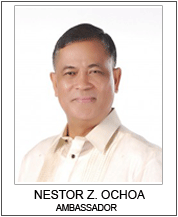
Philippine Ambassador to Greece Nestor Ochoa has asked Filipinos to “exercise caution” especially if they are near demonstrators.
"In view of demonstrations occurring in the center of Athens, and other parts of Greece, I advise the Filipino community in Greece to avoid areas of demonstrations and to exercise caution if they are within the vicinity of demonstrations."
Ochoa added the Embassy is monitoring the developments on bank closures, among other issues attached to the Greek financial crisis.
"The Phil. Embassy is closely monitoring the developments in Greece. Because of the financial situation, banks in Greece are currently closed and capital control is in place but the situation in Greece is generally safe and calm,” said Ochoa.
Earlier, presidential spokesperson Abigail Valte said the government is also willing to extend help to Filipinos in Greece affected by financial crisis in Greece.
Filipinos there said they are not spared from the crisis, being hounded by problems of limited cash withdrawal, delayed salaries, closure of remittance centers, among others.
The alleged decision follows a European Central Bank (ECB) announcement that increases the Emergency Liquidity Assistance (ELA) to Greek banks by 900 million euros
Up until now there has been a 60 euro maximum daily withdrawal limit.
The daily limit will likely stay the same. However, according to reports, depositors will now have the option of not withdrawing the 60 euros each day but instead keeping it in the bank and collecting their total allowance after a day or two. Thus a depositor would be able to withdraw 120 euros or even 180 euros at once rather than wait in an ATM line each day for 60 euros.
Christos Spirtzis, Deputy Minister of Infrastructure, Transport and Networks in Greece, said that the measure of the free movement of citizens in local public transport in Athens is extended to the next working days from Monday 13 and Tuesday, July 14, 2015, in order then to be reviewed.
It is noted that movements of Saturday, the 11th and Sunday, July 12, 2015 will be made according to current policy fare of transport operators, users and for ticket Travelcards.
Normal charged FOR WEEKEND
The measure of free movement of citizens in local public transport in Athens regard to transport operators OASA SA, OSY SA, STASY SA (bus, trolley, Metro, electric railway, tram).
The measure under Law 4331/2015-GG A69 / 01 (Article 77), and the new extension is implemented by Ministerial Decision.
The free movement of passengers in all urban public transport in Athens, is part of solidarity measures to support citizens, which has implemented the Government.
By Filipino Gr*, News reporter in Greece fot tsismosaonline.com
If one was following Greek and international media, it might have seemed as though the difference between the numbers in the Yes and No camps in the Greek referendum was tiny. However, as most ethnographers of Greece would be able to tell you, especially the ones who have spent two years doing research in Athens during the crisis, the No voters were in the overwhelming majority. And so it ultimately proved in the result.
One of the most grotesque moments in the festival of pro-Yes propaganda hosted by Greek TV channels came when a Mega Channel journalist attempted to interview a pensioner in Athens about his views on the debt crisis. The journalist had been expecting the elderly man to complain about the terrible queues at the banks. Instead, the man began to comment on how the crisis has caused thousands of suicides and that he supported the decision to let the people decide. Having failed to get the answer he was looking for, the journalist simply pushed the man out of the frame and quickly began talking over him, while the camera panned away.
Probably one of the best places to understand what is going on in Greece at the moment is in the queues forming at the ATMs of closed banks. People have to wait longer than usual to withdraw cash, and with a daily limit of €60, they are queuing more often, so while there, they just chat with each other spontaneously. Others join in the conversation until you have a small assembly. People address the “audience” loudly, agree and disagree, add comments on top of the main debate and splinter off into their own, smaller groups in the queue. Sometimes people stick around to talk even after they have withdrawn their 60 euros from the ATM.
They talk about their fear but also about their anger. They are angry at the private TV channels and newspapers that spread fear ahead of the vote. They are angry at Greece’s creditors and resent the euro as a currency. In the queue, the conversations are often about the real value of the euro. People still loudly translate their 60-euro allowance into the old Greek currency. They talk about how much they could buy with 20,000 drachma and how little they can get with 60 euros.
They also remember the last time a significant percentage of people in Greece lost substantial amounts of their savings. That was in 1999 when the Athens Stock Market collapsed, just before Greece joined the euro. The government, led by technocrat Costas Simitis had liberated the financial markets as part of the eurozone integration process.
People were encouraged to invest their savings in the financial market via governmental (and TV) propaganda. Small stock market agencies sprung up in towns and villages to help them on their way. The TV sets in the traditional Greek coffee shops broadcast stock market sessions and pink newspapers appeared on the tables. A country with 10 million people was suddenly home to more than 1 million stock-market investors.
Then came the crash. The market collapsed under the weight of several corporate manipulations and investors saw their savings vanish.
At the time, there was enough going on to distract people from the blow. The change of currency to the euro and the devaluation effect made the loss of trillions of drachmas look relatively less significant. People still recall how things that cost 100 Drachma or less quadrupled in value overnight and suddenly cost a euro.
This time around, there are no distractions. But although people fear losing their deposits while the banks remain closed – as happened in Cyprus – the fact is, very few people have much of a deposit to lose.
Beyond what people are talking about as they queue for the ATM, social theory teaches us that large groups with little to lose are a traditional danger for capitalist projects.
The threat they pose was temporarily diffused by the referendum, as they had the chance to express their discontent, but the result makes it clear that they will not be placated for long. The resounding No vote has emerged from a population with no faith in the neoliberal economic system or the mainstream media that presents it to them. They voted no because people are ready to risk losing things in order to win a new political and social deal– especially when what they have to lose doesn’t amount to much.
Unknown peson had informed with email the service center Cyber Alert for the intentions of the Filipina , who finally spotted by the police men, shortly before commit suicide.
The Department of Electronic Crime of Greek Police, after immediate and coordinated action, prevented another case of suicide intent, which was manifested by the Internet user.
Thorough online - police investigation, Police identify digital assets and data of the individual, in order to immediately identify and further ensure the mental health and physical integrity.
Result of the investigation was the identification of electronic trace and geographical location of the Filipina residence in Greece. In collaboration with police officers of the Police Department of the Ambelokipoi Athens, Officers went and found the Filipina woman, who was in good health.
Tsismosaonline.com reporter managed to contact with the Filipina Mother in Greece and asked why she attempted to commit suicide. The mother made the following statement.
Philippines implements a “no late payment” policy wherein students unable to pay their tuition on time are forced to take a leave from the university. My savings in the bank here is for my son's tuition fee to be send in the Philippines and now i can't even get it all and worst can not send it too.
For Tsismosaonline.com 6-7-2015 Filipino Gr
Recall that for such cases, citizens can contact the Department of Electronic Crime, the following contact details:
Yanis Varoufakis has resigned from his post as Greece minister of finance, the economics professor and SYRIZA member announced.
Here is his full statement titled “Minister No More!” as it was posted on his site:
The referendum of 5th July will stay in history as a unique moment when a small European nation rose up against debt-bondage.
Like all struggles for democratic rights, so too this historic rejection of the Eurogroup’s 25th June ultimatum comes with a large price tag attached. It is, therefore, essential that the great capital bestowed upon our government by the splendid NO vote be invested immediately into a YES to a proper resolution – to an agreement that involves debt restructuring, less austerity, redistribution in favour of the needy, and real reforms.
Soon after the announcement of the referendum results, I was made aware of a certain preference by some Eurogroup participants, and assorted ‘partners’, for my… ‘absence’ from its meetings; an idea that the Prime Minister judged to be potentially helpful to him in reaching an agreement. For this reason I am leaving the Ministry of Finance today.
I consider it my duty to help Alexis Tsipras exploit, as he sees fit, the capital that the Greek people granted us through yesterday’s referendum.
And I shall wear the creditors’ loathing with pride.
We of the Left know how to act collectively with no care for the privileges of office. I shall support fully Prime Minister Tsipras, the new Minister of Finance, and our government.
The superhuman effort to honour the brave people of Greece, and the famous OXI (NO) that they granted to democrats the world over, is just beginning.
Greek Prime Minister Alexis Tsipras said that the efforts his government put toward securing the emergency Euro Summit on Monday has proved to be a “success.”
Eurozone country leaders announced a Monday summit to resolve Greece’s prolonged debt crisis that threatens the country’s exit from the common currency bloc.
“We hope that the final negotiations take place at Europe’s highest political level and we are working toward the success of this summit,” Tsipras’ office said in a statement on Friday, a day after citizens rallied on the streets of Athens, pressing the government for a solution to their hardships within the Eurozone.
“The leaders’ summit on Monday is a positive development on the road toward a deal,” the Prime Minister’s office noted, adding that those who were “betting on a Greek crisis and terror scenarios” will be proven wrong.
Tsipras is currently in St Petersburg, Russia, where he will meet with Russian President Vladimir Putin on Friday (today), taking part in talks regarding the construction of the “Greek Stream,” an extension of the TurkStream natural gas pipeline project that will provide Europe with natural gas, as well as Greece’s potential participation in the new Shanghai-based BRICS bank.
Giorgos Thomakos, the mayor of Kifissia suburb in Athens, Greece, was the victim of an armed robbery. According to preliminary information from the Greek Police, armed burglars broke into the mayor’s home and after they tied him and his wife, they took money and jewelry and disappeared. The couple was released by their underage son who was able to go unnoticed by the burglars.
The robbery happened around 3:00 am on Monday. The burglars, whose identity remains unknown, entered Thomakos’ house in Kifissia through a window on the first floor that had not been securely shut. While the family was sleeping, the armed men entered the parents’ bedroom and restrained the couple at gunpoint.
They proceeded with searching the house and removing any cash, jewelry and any other valuables they could find. In the end, they managed to escape without any complications.
Later, the couple’s 7-year-old son, who had been hiding in his room since he heard the robbers enter the house, unrestrained his parents who alerted the police.
Christmas is here and New Year’s day is approaching, so for those wondering how to make their festive dinners and gifts stand out, here are a few ideas that have been a part of Greek culture for years.
During Christmas and New Year’s Eve, most Greeks prepare a spectacular feast for their friends and family and stay up celebrating till morning. Typically, a Greek Christmas or New Year’s Eve meal includes pork or turkey. Pork can be cooked in a variety of ways but it is usually marinated overnight, stuffed with dried fruit, chestnuts and spices, and cooked on low temperature for over four hours. As for turkey, since there is no such thing as a Thanksgiving celebration in Greece, most people cook it on New Year’s Eve or Christmas. The bird is usually stuffed and then cooked in the oven for two to three hours, while it can also be wrapped in bacon, to give it some extra flavor.
There are also many quintessential Greek desserts that are traditionally prepared during the Christmas holidays. Melomakarona and kourambiedes are just some of the sweets that Greek mothers and grandmothers have prepared for many years in order to please their families during the holidays. Melomakarona are small egg-shaped desserts made of flour, olive oil, sugar, orange and honey. After the dough is prepared and the melomakarona are baked, they are dipped in honey syrup and covered in smashed walnuts. Kourambiedes are in many ways similar to shortbread and they are typically made with almonds and brandy or rose water. They are usually shaped as a crescent or a small ball and baked till golden. After they have cooled down, they are covered in icing sugar. Over the last years, many Greek pastry shops have started covering kourabiedes and melomakarona with chocolate, giving a modern spin to an old recipe.
While people across the world are decorating their Christmas trees, many Greeks opt for the Greek tradition of decorating a small ship. Greece was always a maritime country and, in the past, the majority of men worked as fishermen or sea men. For many centuries, Greeks have been decorating small wooden boats in order to express their gratitude for the safe return of their loved ones who were travelling at sea for the rest of the year.
Furthermore, carols or kalanda are a main part of the Greek Christmas holiday season. On the eves of Christmas, New Year and Epiphany, children dust off their triangles, guitars and harmonicas, and rush through the streets, going from door to door, asking home owners “Shall we sing?” If the owners agree, then the children will sing the kalanda and receive some money in return. In the past, people would give out sweets and pastries but the tradition has changed over the years. Maybe this year, adding some Greek kalanda to the festive songs playlist is something to consider.
On New Year’s Eve, Greeks have the tradition of cutting the vasilopita, a cake which contains a hidden coin, at midnight, in order to bless the house and bring good luck for the new year. People around the table receive one piece of cake each by order of age, from eldest to youngest. The person that finds the coin receives a gift, usually a good luck charm. Furthermore, Greek housewives hang a pomegranate above their doors at the beginning of the twelve days of Christmas. On the midnight of New Year’s Eve, all the house lights are turned off and one person that is considered lucky, takes the pomegranate and smashes it on the floor in order to reveal its seeds as a sign of welcoming the new year. Pomegranates are considered a lucky fruit in Greece and symbolize fertility.
The European Court of Human Rights condemned Greece for violating a Human Rights Convention article regarding inhuman and degrading treatment in two separate cases.
The first court decision concerns an Iranian national who arrived in Greece on November 13, 2010 seeking asylum and was held at the border stations of Soufli, Ferres and Alexandroupolis for six months. When he was finally released, his request for asylum was denied by Greek authorities.
The Iranian man claims that the appeal against his request denial is still pending since April 25, 2011. In his action he also states that he was held for six months without trial and was released two days before the official deadline, with a temporary visa. He was forced to live homeless, and in poverty, under degrading conditions.
The Court has vindicated him, condemning Greece for inhuman and degrading treatment of an asylum seeker and ordered the state to pay 6,500 euros in compensation for moral damage.
Meanwhile, the European Court of Human Rights also condemned Greece on a second case for the violation of a migrant’s right to liberty and security, as well as for the inhuman and degrading treatment that he suffered. Iraqi national, Hussein Mohammed was arrested for illegal entry on November 15, 2010 in Soufli, northern Greece when he was just seven years old.
His age had to be determined since a Frontex officer claimed incorrectly that he was born in 1990. Later, he was transferred to the juvenile detention center in Soufli and given 30 days to leave Greece and go to Germany where his brother was waiting for him.
The Court condemned Greece for violation of the right to liberty and security and for inhuman and degrading treatment of a person, forcing the state to pay the Iraqi national 8,500 euros as compensation.
A group of 15-20 men wearing hoods attacked the Vyronas police station throwing molotov cocktails at around 10:30 p.m. the evening of December 4.
The men attacked the station on Agiou Dimitriou street suddenly and fled immediately. The fire from the molotov cocktails damaged a police vehicle parked in front of the station.
The rest of the night was marked by similar arson attacks against banks, state buildings and vehicles all over Attica, Greece.
At 2:30 a.m., an unidentified men threw molotov cocktails setting fire to the entrance of a bank on Gounari street in Glyfada. A little later, five vehicles belonging to National Hellenic Telecommunications (OTE) were burned on Amorgou street in Egaleo.
At 3:45 a.m., fire was set to the ATM of a bank on Trion Ierarchon streen in Petralona, while e few minutes later three small gas containers exploded in front of another bank in Galatsi.
Finally, at around 5:00 a.m., unidentified men threw gas containers that exploded at the entrance of the courts building on Evelpidon street causing damages to the outpost